
Yogyakarta, Voicejogja.com – In the epic world of Javanese puppetry (Wayang), there exists a secret doctrine known as Sastra Jendra Hayuningrat Pangruwating Diyu. It is a spiritual science said to be capable of liberating humans from the “giant” (Diyu) nature residing within their souls.
Yet, the history of this teaching is shrouded in the dramatic tragedy of Sage Wisrawa and Princess Sukesi, a tale of how even the highest knowledge can lead to downfall without self-control.

For the people of Yogyakarta and Java, Sastra Jendra is not merely an ancient myth found in dusty manuscripts. It is understood as a path to preserving humanity, controlling desires, guarding the intellect, and seeking a balanced life.
The Meaning of the Secret Doctrine
In Javanese philosophical tradition, every word in Sastra Jendra Hayuningrat Pangruwating Diyu carries a profound weight:
-
Sastra: Knowledge or a spiritual tool.
-
Jendra: High-level wisdom for humanity or leaders.
-
Hayuningrat: The effort to beautify and save the world.
-
Pangruwating Diyu: The process of liberating humans from their primal, monstrous characteristics.
As a whole, this teaching is a spiritual roadmap for purifying negative human traits toward the nobility of the soul.
Traces in Javanese Literature
The teachings of Sastra Jendra are woven into various classic Javanese literary works. Philologists find its traces in the Serat Sastrajendra by the legendary Surakarta poet, Raden Ngabehi Yasadipura I.
Its philosophical roots also connect to the Serat Arjunawijaya by Mpu Tantular from the Majapahit era, and the world-renowned Javanese encyclopedia, Serat Centhini. One verse in Serat Sastrajendra describes it beautifully:
“Sastra Jendra Hayuningrat, a tool for nobility, to beautify the world, to neutralize the anger of the mind, becoming the path to perfection, and unity with the Creator.”
The Tragedy of Sage Wisrawa: A Symbol of Human Desires
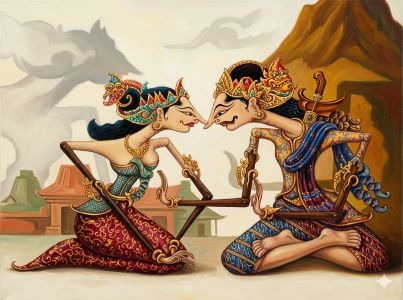
The most famous story associated with this doctrine is that of Sage Wisrawa. He was a holy priest who intended to teach this secret wisdom to Princess Sukesi to free her from worldly bonds.
However, the transmission of this sacred knowledge turned into a tragedy of the flesh. In the Wayang tradition, it is told that the deities intervened: Batara Guru entered Wisrawa’s body, and Batari Uma entered Sukesi’s. The spiritual encounter shifted into carnal passion.
From this event, four children were born, symbolizing the four fundamental human traits:
-
Rahwana: Symbolizing greed and unbridled rage.
-
Kumbakarna: Representing sloth and inertia.
-
Sarpakenaka: The symbol of lust.
-
Gunawan Wibisana: Representing intellect, conscience, and wisdom.
This story serves as a stern warning: even the highest knowledge can bring destruction if not accompanied by absolute self-mastery.
Relevance in the Modern Era
In modern life, Sastra Jendra is understood symbolically. The “Diyu” or giant is no longer a fanged creature, but the negative traits within, greed, hatred, and the abuse of power. It reminds us that progress in knowledge without the beauty of character (Budi) leads only to ruin.
Thus, Sastra Jendra is an invitation for “self-purification” (Ruwatan Diri).
The Path to Unity: Manunggaling Kawula Gusti
The ultimate goal of Sastra Jendra is to achieve Manunggaling Kawula Gusti, the mystical union between the human and the Creator. It teaches that the Divine is not far from humanity but resides in the depths of the heart.
When the ego is dissolved, humans are expected to live in harmony with the Divine Will, becoming a source of peace (Memayu Hayuning Bawana) for society and nature.(Oi/Supriyadi)