
Yogyakarta, Voicejogja.com – In the quiet corners of Yogyakarta’s coffee shops and family living rooms, the conversation about Weton, the traditional Javanese birth-cycle system—remains vibrant. For many, Weton is more than just a birth date; it is a profound way to navigate life’s direction, particularly regarding the concept of luck and fortune.
In an ever-changing era, the question of which Weton is the most “fortunate” has regained relevance. In the Javanese worldview, luck is not merely a stroke of fate, but a harmonious blend of character, cosmic alignment, and deliberate effort.

Reading Fortune through Sacred Manuscripts
Referring to ancient manuscripts such as the Primbon Betaljemur Adammakna, the concept of luck is multifaceted. It arises from the balance of three elements: Neptu (numerical value), Rakam (character traits), and Pancasuda (life path).
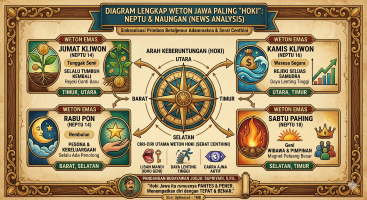
Certain Wetons are often described as having a “celestial advantage.” Kamis Kliwon (Thursday Kliwon), for instance, is said to be under the influence of Wasesa Segara, symbolizing vast prosperity and a resilient spirit.
Rabu Pon (Wednesday Pon) is linked to a calming energy, where luck often manifests through warm social connections and timely assistance from others. Meanwhile, Jumat Kliwon (Friday Kliwon)—often misunderstood by outsiders—possesses the Tunggak Semi character, signifying a fortune that regrows even after being exhausted. Sabtu Pahing (Saturday Pahing), with its high numerical value, is considered a magnet for leadership and vast opportunities.
The Anatomy of a Fortunate Spirit
According to the Serat Centhini, a masterpiece of Javanese literature, luck is not only read from numbers but also from behavior. Those believed to have a strong “lucky streak” often display specific traits.
One such trait is Idhu Geni, the power of the word, where one’s speech aligns with their intentions, often leading to manifestation. There is also “resilience,” the ability to bounce back from adversity without ever hitting rock bottom. Modern observers might interpret this as an intuitive sharpness in reading business or relational opportunities.
A Rational Reinterpretation: Beyond Fatalism
Yogyakarta cultural expert, Supriyadi, S.Fil., warns against a fatalistic understanding of Weton. In his view, the Javanese concept of luck is remarkably rational.
“Many people ask which Weton is the luckiest. In reality, the Javanese formula for luck is Pantes and Pener (Appropriateness and Rightness),” Supriyadi explains. Luck, he argues, occurs when a person is in the right place with the right attitude.
In today’s context, this translates to readiness to seize opportunities. Interestingly, those born with “large energy” Wetons are expected to carry a broader social responsibility. “Those with fortunate Wetons are destined to be channels of blessings for others,” he emphasizes.
The Future of Fortune: ‘Laku’ and Consistency
In Javanese manuscripts, even the most fortunate individuals are advised to undergo Laku Prihatin, a disciplined spiritual and physical practice. Luck is not something that falls from the sky without merit.
The concept of Ngundhuh Wohing Pakarti (reaping what one sows) serves as a reminder that results always follow actions. Weton is merely the seed; it requires hard work, character, and consistency to bear fruit.
Ultimately, for the Javanese people, the most valuable form of luck is not what one gains, but the extent to which one’s presence benefits others. This is the essence of Rahayu, to be safe, sufficient, and meaningful to society.(Oi)