
Sleman, Voicejogja.com – Grojogan Watu Purbo has once again solidified its position as a living laboratory for community-based tourism development in the Special Region of Yogyakarta.
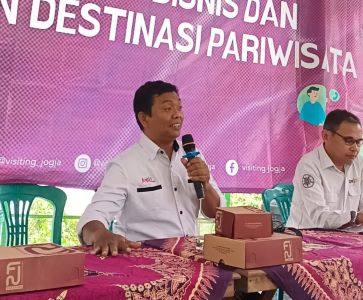
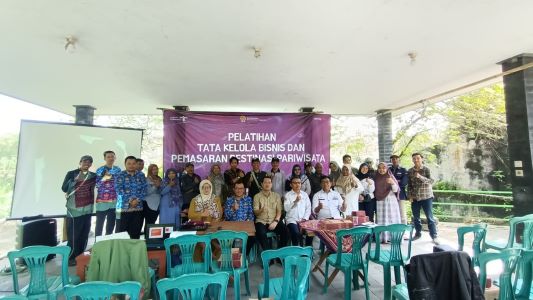
On Monday, April 27, 2026, the Grojogan Watu Purbo Pendopo in Merdikorejo, Tempel, Sleman, hosted a training session on Business Governance and Destination Marketing. The event centered on a strategic theme: “Sustainable Tourism Destination Business Models.”

The session featured Agus Budi Rachmanto, Head of Industry Capacity Building at the Indonesian Tourism Industry Association (GIPI), as the keynote speaker. His presence provided a comprehensive perspective on how tourist destinations must transform from simple attractions into sustainable economic, social, cultural, and environmental ecosystems.
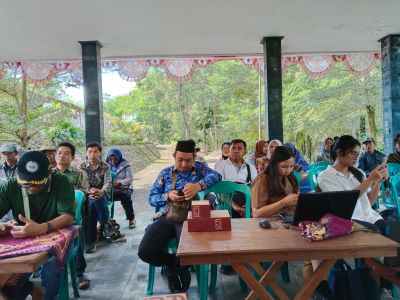
In his presentation, Agus emphasized a fundamental shift in the paradigm of destination management. While success was once measured by the quantity of visitors, the modern era shifts the focus toward the quality of experience, distribution of economic benefits, environmental resilience, and socio-cultural sustainability.
“Sustainable tourism is not just about environmental conservation; it is about striking a balance between economic growth, environmental preservation, and community welfare. Future destinations are those that grow without losing their identity and develop without destroying their source of life,” stated Agus Budi Rachmanto.
The sustainable business model concept presented places revenue diversification as the foundation of economic resilience. Relying on a single income source, such as entrance fees, is considered high-risk in a dynamic market.
Therefore, destinations need to develop various business lines, including experience-based tourism, guiding services, event organizing, local culinary offerings, merchandise, homestays, and strengthening the MSME (UMKM) ecosystem.
In the context of Grojogan Watu Purbo, this potential is highly relevant. Its terraced waterfall landscape, geological Merapi backdrop, and active community involvement provide a strong competitive edge and differentiation. The waterfall is more than just a visual attraction; it is a living narrative of natural transformation, community resilience, and localized development harmony.
Agus also highlighted the importance of community-based tourism as the bedrock of governance. In this model, local residents are not merely spectators but owners, managers, and primary beneficiaries. This approach ensures that the economic growth generated by tourism has a wide-reaching multiplier effect on the surrounding community’s welfare.
Furthermore, destination marketing in the digital age demands a shift from mere promotion to the creation of experiences and storytelling. Modern travelers no longer just “buy” a destination; they seek stories, emotions, and meaning.
Thus, Grojogan Watu Purbo must effectively communicate its unique identity as a destination born from the transformation of Merapi’s volcanic flows into a source of life and inspiration.
Multistakeholder collaboration was also noted as a decisive factor. Government, industry players, academics, communities, media, and investors must move in a synchronized orchestration of development. No destination can grow in isolation; success is always a collective synergy.
Philosophically, Grojogan Watu Purbo offers a profound metaphor. Its six tiers of waterfalls can be interpreted as stages of destination development: potential, management, collaboration, innovation, growth, empowerment, and sustainability.
The constantly flowing water symbolizes the dynamics of change, while the ancient stones (Purbo) stand as symbols of steadfast values and identity.
Through this initiative, Grojogan Watu Purbo continues to serve as an inspiring model for sustainable tourism development in Indonesia. From the slopes of Merapi, a vital lesson emerges: when nature is preserved, communities are empowered, and businesses are managed with long-term vision, tourism becomes a true force for transformation.(Oi)