
Yogyakarta, Voicejogja.com – On the fingers that work, pray, and greet others, there is a small circle often overlooked in its deeper meaning. The ring (known in Javanese as Ali-ali or Kalpika) is not merely an ornament; it is a profound trace of a long cultural journey that remains alive in the daily lives of Javanese people.
In Yogyakarta, where tradition and modernity walk hand in hand, the meaning of a ring transcends aesthetics. It is a reminder, an identity, and a piece of spiritual heritage.

From Ornament to a Symbol of Life
The ring is known as one of the oldest forms of jewelry in human history. Its circular shape, without beginning or end, makes it a universal symbol of eternity, life cycles, and unity.
In the Javanese context, rings are referred to by various names: Ali-ali, Sesupe, or Kalpika in Sanskrit. Each term carries a nuanced meaning, ranging from the familiar to the sacred.
Ali-ali is not just an adornment; it is deeply attached to the concept of Piyandel, a life principle that reflects the character, hopes, and prayers of the wearer.
Ancient Footprints in Nusantara History
Since ancient times, rings have been an integral part of the social and spiritual structure of society. Reliefs at Borobudur and Prambanan Temples depict noble figures wearing intricate hand jewelry.
During the Majapahit era, ring craftsmanship reached its peak. Granulation techniques and precious stone settings showed that rings were not only about aesthetics but served as markers of social status.
In Old Javanese inscriptions, rings (Simsim) were recorded as official gifts during land inauguration ceremonies, signifying authority and legitimacy.
Kalpika in Literature and Spirituality
In Javanese literature, rings often appear as a Tetenger, a sign that binds meaning to significant events. In the Ramayana epic, a ring serves as the ultimate proof of identity when Hanuman brings Rama’s Kalpika to Shinta. It was not just an object, but a vessel for trust and love.
Meanwhile, in the Serat Centhini, rings are described as jewelry that radiates light, believed by some to ward off misfortune. Manuscripts like Serat Naklasanjir emphasize that a ring must harmonize with the wearer’s character, a spiritual relationship between humans and nature.
Structure of Meaning: The Vessel and the Core
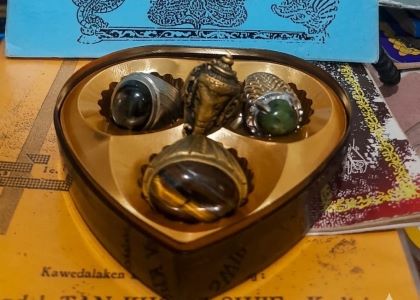
In Javanese tradition, a ring consists of two main elements: Embanan (the frame) and Sesotya (the stone). Gold (Kencana) symbolizes majesty, silver brings tranquility, while Pancalogam (a five-metal alloy) is believed to provide protective strength.
Gemstones are never chosen at random. The Red Ruby (Mirah Delima) symbolizes courage, Sapphires (Nilam) bring calmness, and Diamonds (Intan) reflect inner clarity. This relationship shows that a ring is a convergence of physical form and spiritual essence.
From the Palace to Modern Life
Over time, the meaning of the ring has continued to transform. Once a symbol of power within the Keraton (Palace), it now exists in everyday life as part of personal identity.
In Yogyakarta, the Akik (agate) and Ali-ali culture once became a massive phenomenon, showing how old heritage can be revived in a new context. Today, the younger generation sees rings as a part of heritage, connecting the past with contemporary self-expression.
The Unbroken Circle
More than just an accessory, a ring stores a message about what humans wish to protect in their lives. It can be a token of a promise, a symbol of love, or a reminder of one’s roots, as reflected in the word Sesupe, derived from Aja Supe (Do Not Forget).
Inside that small circle lies a grand idea of wholeness, balance, and the human connection to the self, others, and the universe.(Oi/Supriyadi)